
 Configurator
 Contact
Van, campervan or motorhome: what are the differences and which one should you choose?
Vans, campervans and motorhomes cater to different needs, and the largest isn’t always the most suitable. The right choice depends on five criteria : size, number of seats, comfort, regulations and budget.
Key takeaways:
- Height makes all the difference. At under 2 metres, the van handles and parks just like a car. Panel vans and campervans offer more interior space.
- The van can carry the most passengers – up to 7 Depending on the model, whilst most vans offer 2 to 4 seats.
- Vans and motorhomes have the advantage when stationary, because you can stand up in them and they have built-in toilets.
- For vehicles weighing up to 3.5 tonnes, a Category B licence is sufficient for all three vehicles.
- The purchase price is the same, but the gap widens with use (tolls, fuel, insurance, maintenance).
At Glénan Concept Cars, we build campervans in Brittany, but a campervan isn’t for everyone. This comparison therefore also looks at panel vans and motorhomes, to help you choose the vehicle that best suits your travelling style.
What is the difference between a van, a minivan and a motorhome?
The difference between a van, a campervan and a motorhome is primarily down to body size, which extends from the base of the vehicle.
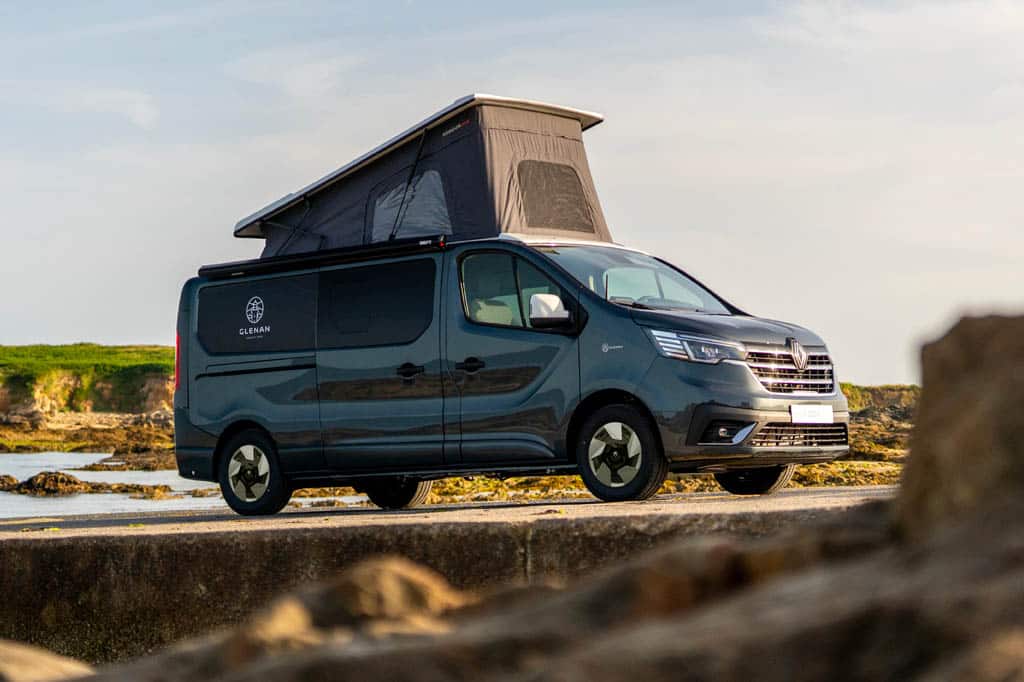
- Le converted van is based on a compact van such as the Renault Trafic. It is approximately 5 metres long and less than 2 metres high.
- The campervan is based on a large commercial vehicle (Fiat Ducato, Citroën Jumper, Peugeot Boxer), measuring between 5.40 and 6.36 metres in length and between 2.50 and 2.90 metres in height.
- A motorhome with a body-on-frame design combines a chassis-cab with a built-in body (semi-integrated, coach-built or full-integrated). It is generally over 6 metres long and 2.90 metres high.
The van prioritises manoeuvrability and passenger capacity; the campervan adds on-board toilet facilities; the motorhome offers the most living space.
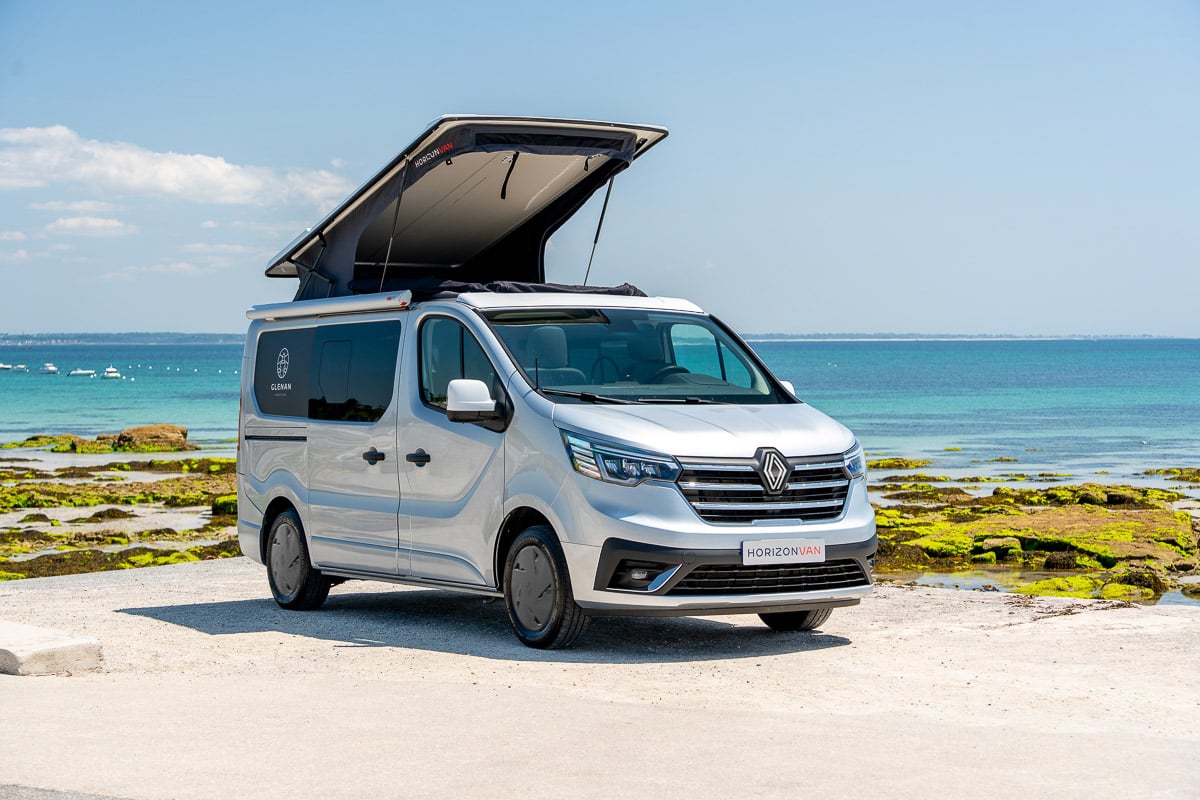
| Criteria | Van (formerly HorizonVan) | Fitted van | Motorhome with a living area |
|---|---|---|---|
| Length | ~5 m (HorizonVan 5: 5.08 m) | 5.40 to 6.36 metres | 6 to 8.10 m, depending on the type |
| Height | 1.99 to 2.05 m | 2.52 to 2.88 m | 2.88 to 3.40 m |
| Seating | Up to 7, depending on the model (HorizonVan range) | 2 to 4 | 4 to 5, up to 7 in nasturtiums |
| Sleeping accommodation | 4 (bench seat and pop-up roof) | 2 to 4, fixed bed available | 2 to 7 |
| Toilets | Outdoor shower, portable toilet (optional) | Bathroom, often built-in | Bathroom, sometimes with a separate shower |
| Standing upright | Raised roof only | Yes | Yes |
| Licence | B | B | B up to 3.5 tonnes, C1 above that (often full-size motorhomes) |
| Toll class | Class 1 | Class 2 | Class 2, Class 3 for the highest ones |
| Consumption | 7 to 8 litres per 100 km | 9 to 12 litres per 100 km | 9 to 20 L/100 km depending on the model |
| New price | €40,000 to €70,000 | €55,000 to €90,000 | From €50,000 to over €200,000 |
| Insurance | €350 to €700 per year | €500 to €1,200 per year | €450 to €1,500 per year, depending on the type |
| Annual review | €700 to €1,300 | On average, between a van and a motorhome | €1,200 to €2,500 |
| Daily use | Yes, perhaps the only car in the household | Possible, but restrictive | No, a dedicated leisure vehicle |
| Discretion | Looks like a people carrier or a minivan | Classified as a recreational vehicle | Highly visible |
The market in France in 2025: 14,410 new vans and light commercial vehicles registered, compared with 11,918 motorhomes, and 68,041 second-hand motorhomes (UNI VDL data).
The 5 criteria for choosing between a van, a panel van and a motorhome
How vehicle dimensions affect driving on the road
The van is the only one of the three that handles like a car. Being longer and taller, the panel van and campervan offer more space but less freedom of movement.
The van takes the back roads, passing through villages and natural sites that larger vehicles tend to avoid. With its tight turning circle, it handles just like a large people carrier. A 6-metre van or a 7-metre motorhome requires you to plan every U-turn in advance and is more susceptible to crosswinds.
Height also determines access. The van can pass through gantries with a height of 2 m, but not through underground car parks limited to 1.90 m. At home, it fits into a standard parking space, whereas a van or motorhome requires a driveway 6 to 8.5 metres long or a secure parking facility (€600 to €1,320 per year for a van).
How many of you will be on board?
Before going to bed, count the seatbelts. You need one approved seatbelt per passenger, and this is where the van really stands out.
Thanks to its rear bench seat and sunroof, an HorizonVan The 5 model offers 5 seats and 4 berths, whereas most campervans offer 2 to 4 berths. Before buying, check the number of seats stated on the vehicle registration document.
The payload is also worth bearing in mind. On a 3.5-tonne vehicle, there is generally 400 to 600 kg available for passengers, water, luggage and bicycles. With four or five people on board, this allowance is quickly used up, and an overloaded vehicle risks a fine or even being impounded.

How comfortable is it when it’s stationary?
Once parked, both the campervan and the motorhome offer headroom and on-board toilet facilities – two features that the van simply cannot match.
The living space ranges from around 4 to 5 m² in a campervan, to 6 to 8 m² in a camper van, and 9 to 14 m² in a motorhome. In a campervan, you spend more time outdoors, and the bed can be made up in under 15 seconds in the HorizonVan 5.
For two people, the range without refuelling is similar for campervans and panel vans (2 to 4 days), and slightly longer for motorhomes (3 to 5 days) thanks to their 100 to 150-litre tanks. As for electricity, a living area battery and a solar panel take 2 to 4 days by van, and up to 7 days by motorhome.
For winter, a well-insulated motorhome is the way to go. A campervan is more suited to three seasons, as its fabric pop-up roof offers less insulation, even though the HorizonVan The 5 comes with a Webasto heater as standard (see our tips for travelling by campervan in winter).
Regulations (driving licences, tolls, parking)
Up to 3.5 tonnes, the law treats all three vehicles as cars. The differences lie in their height and weight.
- Licence : the Category B driving licence Sufficient for vehicles up to 3.5 tonnes. Above this limit, particularly for integrated motorhomes, you need a C1 licence or the B79 endorsement, and speed limits are reduced (110 km/h on motorways, 100 km/h on expressways, 80 km/h elsewhere).
- Toll : below 2 m, the van remains in Class 1, just like a car. Vans and motorhomes fall into Class 2. On a journey from Paris to Lyon, expect to pay €41.30 in a van compared with around €64 in a motorhome.
- Sleeping on the public highway : the rule is the same for all three. The vehicle must simply be parked, with its wheels on the ground and nothing protruding, A maximum of 7 days in the same place. A raised roof remains a grey area.
- ZFE : a Euro 5 or 6 diesel vehicle is eligible for the sticker Crit’Air 2 and travels everywhere.
- Vehicle registration certificate : it must bear the VASP «motorhome» marking, which is the case for a van fitted out by a manufacturer. A DIY conversion requires DREAL approval, which takes between 2 and 4 months.
The budget (purchase, insurance, fuel, maintenance)
At the time of purchase, the price ranges overlap. The difference becomes apparent in use, with the van coming out on top.
The van works out cheaper on a day-to-day basis thanks to its Class 1 toll classification, lower fuel consumption (a panel van uses around 30 per cent more fuel, whilst an integrated motorhome uses around 65 per cent more) and lower maintenance costs. With a motorhome, the weight causes the brakes, tyres and suspension to wear out more quickly, and the living area means you need to keep an eye on waterproofing, gas and water levels.
Overnight stays are the only area where the van loses out. Without on-board toilet and shower facilities, it is more reliant on campsites, whereas campervans and motorhomes make better use of service areas. For full pricing details, see our article on the price of a new campervan.
Van, minivan or motorhome: who are they for?
Every vehicle has its own playground. Here’s who each one is best suited to.
The campervan: for travelling in a large group without sacrificing freedom of movement
The van is aimed at couples and families of up to five, or even seven, which set off regularly, from weekend trips to long journeys. It goes where larger vehicles hesitate to go and carries more passengers than most minibuses. On the other hand, life on board is more focused on the outdoors. It also appeals to young retirees who want a single vehicle for both everyday use and travel, and who want to set off whenever they please, including out of season.
- Perfect for you if : whether you’re travelling as a group of four or five, enjoy country lanes, villages and natural landscapes, want a vehicle that’s fully equipped yet easy to handle, or simply don’t have space for a large vehicle at home.
- Less suitable if : you want a built-in shower and toilet, you want a fixed bed that’s always ready, or you’re mainly going away for long periods in winter.
The campervan, for travelling as a couple in greater comfort
The minibus is ideal for travellers who want indoor sanitary facilities, a fixed bed and high ceilings, generally for couples, but also for a family of four with a family-friendly layout. This means you’ll need to accept a height of over 2.50 metres, Class 2 tolls and more restrictive parking.
- Perfect for you if : Whether you’re travelling as a couple or as a family of four in a family-sized model, the on-board bathroom facilities are important, and you’ll be spending long periods at motorhome sites.
- Less suitable if : there are more than four of you, you often drive in the city centre or on narrow roads, or you have neither a driveway nor a garden to park it in.
The motorhome with a separate living area, for living space on long trips
The motorhome prioritises space, featuring a lounge, a fixed bed, a separate shower and large water tanks. It is ideal for travellers who stay in one place for long periods and for large families in a capucine-style motorhome. However, its size restricts access to narrow roads and town centres.
- Perfect for you if : you’re going away for several weeks, interior comfort is more important than manoeuvrability, or you’re travelling with five or more people in a pop-up campervan.
- Less suitable if : you like to plan your stops on the spur of the moment, you want to keep your running costs down, or you don’t have anywhere to store your belongings.
Van or minivan – which one should you choose?
Van or motorhome: what are the differences?
A van or minivan for a family of four or five?
Is it allowed to sleep in a van in town?
What is the range of a campervan?
Methodology and sources
The dimensions and specifications are taken from the manufacturers’ technical data sheets (Renault, Fiat) and from HorizonVan data for our own models. Prices, insurance premiums and maintenance costs are ranges obtained in September 2026 from dealers, garages and insurers. Fuel consumption figures and annual budgets, calculated from this data, provide approximate figures that vary depending on driving style and load. The regulations cited refer to official texts and websites. Last updated: October 2026.