
 Configurator
 Contact
Pop-up roof on a campervan: why is it an essential feature?
Garer son van dans le parking souterrain d’une ville, payer le péage au tarif voiture, puis, le soir venu, cuisiner debout et monter dormir à l’étage. Un van aménagé à toit relevable permet tout cela. Encore faut-il bien choisir son toit et en connaître les limites.
Ce qu’il faut retenir
- Toit fermé, un van compact à toit relevable peut rester sous 2 mètres, ce qui lui ouvre la classe 1 au péage et les parkings à barre de hauteur.
- Toit ouvert, il permet de se tenir debout dans le carré de vie et ajoute un lit double à l’étage.
- Le toit surélevé fixe offre plus de volume en permanence, mais le véhicule dépasse alors les deux mètres de haut.
- Ses limites tiennent à la toile, moins isolante qu’une paroi et à la centaine de kilos qu’il ajoute.
Comment fonctionne un toit relevable sur un van aménagé ?
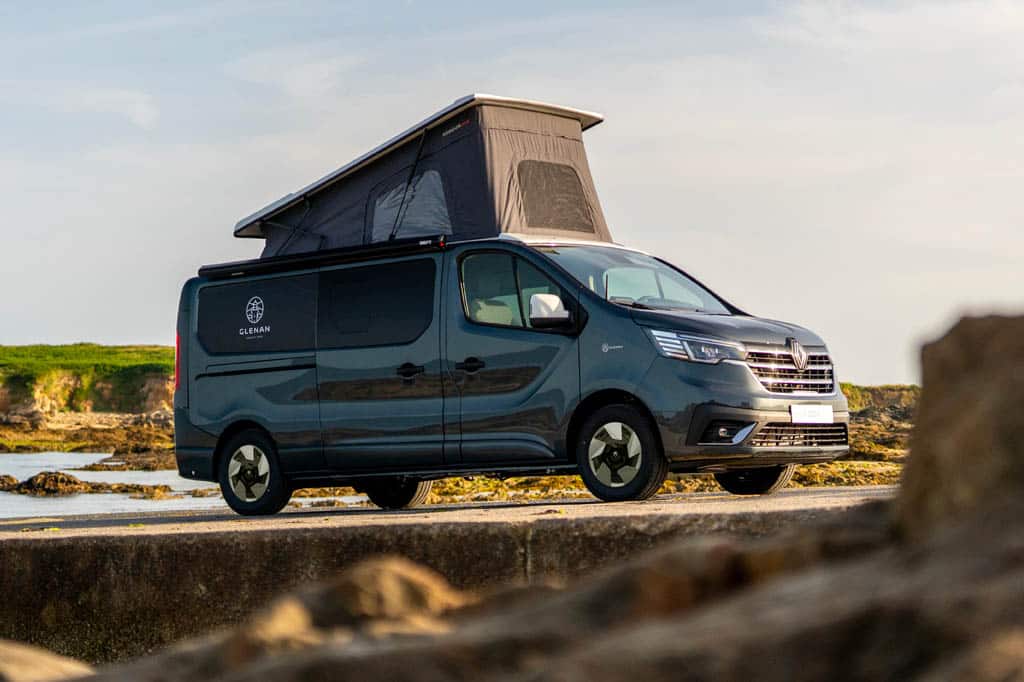
Le toit relevable remplace une partie du pavillon d’origine par une coque qui se lève à l’arrêt. Une toile se déplie entre la coque et la carrosserie, et des vérins assistent l’ouverture.
Le plus souvent, le toit est articulé à l’arrière et se relève du côté cabine, mais certains modèles se lèvent à l’horizontale. La plupart utilisent une toile, parfois doublée, avec des fenêtres à moustiquaire. Quelques aménageurs proposent des toits à parois rigides, souvent électriques, qui isolent mieux au prix d’une mécanique plus complexe.
Toit relevable, toit surélevé ou toit standard : quelles différences ?
Le toit standard conserve le pavillon d’origine. Le toit surélevé le remplace par un toit haut fixe, comme sur les versions hautes des utilitaires. Le toit relevable ne prend de la hauteur qu’à l’arrêt.
| Critère (van compact) | Toit standard | Pop-up roof | Toit surélevé fixe |
|---|---|---|---|
| Hauteur sur route | Moins de 2 m | Moins de 2 m selon le modèle | Plus de 2 m |
| Classe au péage | Classe 1 | Classe 1 si la hauteur reste sous 2 m | Classe 1 si la hauteur reste sous 2 m |
| Parkings à barre de hauteur | Accessibles | Accessibles selon la hauteur | Souvent inaccessibles |
| Se tenir debout | No | Oui, toit ouvert | Oui, en permanence |
| Couchage supplémentaire | No | Lit double à l’étage | Selon l’aménagement |
| Isolation | Celle de l’aménagement | Plus faible au niveau de la toile | Proche d’une cellule |
| Silhouette | Celle d’un van classique | Celle d’un van classique, toit fermé | Plus haute et plus visible |
Sur un van compact, seul le toit relevable réunit station debout, couchage supplémentaire et gabarit de voiture. Le toit surélevé se justifie plutôt pour de longs séjours par temps froid, quand la hauteur du véhicule importe peu.
Van compact ou fourgon : le toit relevable ne joue pas le même rôle
Un fourgon à toit relevable et un van à toit relevable ne répondent pas au même besoin. Sur un van compact comme le Renault Trafic aménagé, le toit fait gagner de la hauteur et un lit sans faire sortir le véhicule de la classe 1. Un grand fourgon, plus large et plus haut, dépasse déjà les 2 mètres sans toit relevable. Celui-ci n’y change donc rien au péage ni aux parkings, et sert surtout à ajouter deux couchages.
Le fourgon offre plus d’espace, souvent une salle d’eau et un lit fixe. Le van aménagé avec toit relevable mise sur la polyvalence et peut servir de véhicule du quotidien. Notre comparatif van, minivan or motorhome sets out the other criteria.
Staying under 2 metres: what this means for everyday life
This bar is often a deciding factor when choosing between a van and a panel van. To make the most of it, the vehicle’s actual height – including the closed roof and fixed fittings – must remain below this limit.
Pay the car toll at the toll booth
On French motorways, Class 1 comprises vehicles with a total height of 2 metres or less and a gross vehicle weight rating (GVWR) of 3.5 tonnes or less. Above this limit, and provided the vehicle remains under 3 metres in height, it is classified as Class 2, which is significantly more expensive. Some toll lanes are also fitted with a height barrier and are reserved for Class 1 vehicles.
Access to car parks and toll gates
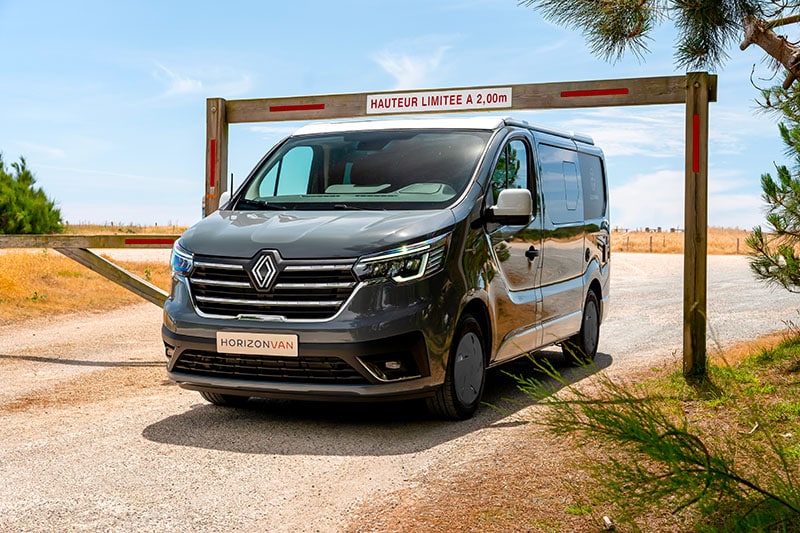
Underground car parks, town centres and access roads to beaches are often fitted with height restrictions. A van that stays below the height limit can drive through, and depending on the height of the door, it may even be able to park overnight in a private garage. Be wary, however, of roof bars, a roof rack or a solar panel, which may cause the vehicle to exceed the height limit, and ask for the vehicle’s height, including any optional extras.
Standing desk and bed upstairs
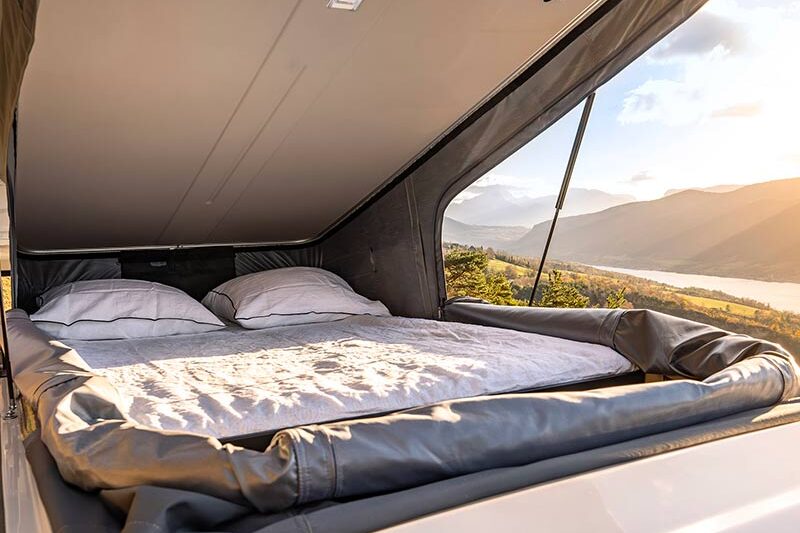
Without a pop-up roof, a compact campervan means you have to hunch over, which quickly becomes a nuisance when cooking, getting dressed or spending an evening inside when it’s raining. With the roof open, you can stand upright in the living and kitchen area once the bed base has been raised. At night, the space beneath the roof houses a double bed, meaning a compact van can sleep four people: two downstairs on the convertible bench seat and two upstairs. On the market, roof beds are generally between 120 and 140 cm wide and 1.90 to 2 m long.
To compare, look at the width of the mattress, whether it has a slatted base, how easy it is to get in and out, and how easy the pop-up roof is to operate. The upper level also provides privacy, as parents and children do not sleep in the same space. If you’re looking for a 4-berth campervan with pop-up roof, our page 4-seater campervans shows the available configurations.
How should it be used depending on the season?
On sunny days
In summer, we’re happy to leave the roof open all day. The mosquito-net windows allow air to circulate inside the cabin, and on some models, the canvas opens wide at the front, as on our Horizon modelsVan With the canvas opening up to a 180° panoramic view, it’s the perfect way to fall asleep and wake up to a beautiful view.
In mid-season and in winter
In cold weather, the upper bunk cools down faster than the rest of the van. A lined canvas cover or an insulating cover, a stationary heater and good ventilation to prevent condensation can make all the difference. In very cold weather, sleeping downstairs with the roof closed reduces the volume that needs to be heated. The design of the bed also matters: on some models, a micro-perforated bed cover channels heat from the stationary heater right into the roof bed.
The drawbacks of a pop-up roof
Before buying, there are four limitations to bear in mind. A pop-up roof weighs around a hundred kilos, which reduces the payload. Its fabric provides less insulation than a wall, both against the cold and against the sound of rain.
On some models, opening the roof requires some effort, and closing it involves pulling the fabric in whilst holding the roof in place. It is therefore best to try this out before buying: some double-cylinder actuators, such as those from *L’Horizon*Van, make them much easier to handle.
How much does a campervan with a pop-up roof cost?
A pop-up roof, available as an option, costs in the region of €6,000 to €7,000 (indicative retail prices from a number of conversion specialists).
To find the van aménagé à toit relevable The cheapest option isn’t enough – it’s not just about the purchase price. A poorly insulated awning, or one whose fabric ages quickly, will end up costing you more in the long run. In the Horizon rangeVan, the pop-up roof comes as standard on all our models, starting at €55,690.
The Horizon pop-up roofVan, designed and manufactured in Brittany
At Glénan Concept Cars, a Breton manufacturer with over 20 years’ experience, we have been designing our own pop-up roof since 2016 and travel in the Horizon ourselvesVan. We designed it to overcome the usual limitations of a pop-up roof.
- Extra-flat, he keeps his eyes on the horizonVan under 2 metres, even with an awning or a solar panel, and allows it to travel in Class 1 on ferries.
- Designed to keep things light, it preserves the payload.
- For winter, the Webasto heater with altitude kit comes as standard. With the Signature Pack, the roof bed becomes heated: its micro-perforated cover distributes the heat from the auxiliary heater. An insulated cover is also available as an option.
- Double-cylinder jacks make it easier to handle, and an intermediate position allows the fabric to be folded back before the roof is closed.
- Designed for marine use, with an insulated polyester and polyurethane shell, it is manufactured in Brittany by a local partner, and its waterproofing is guaranteed for 5 years.
- Under the roof, a 140 x 198 cm bed (shoulder width) on a wooden slatted base, with an optional panoramic opening canopy.
The easiest way to form your own opinion is still to try out the roof for yourself. Our showrooms de Quimper, Bordeaux et Lyon vous accueillent pour une démonstration, et vous pouvez aussi découvrir les autres atouts de l’HorizonVan ou composer le vôtre avec notre configurator.