



Campervan fitted with solar panels : battery life and installation
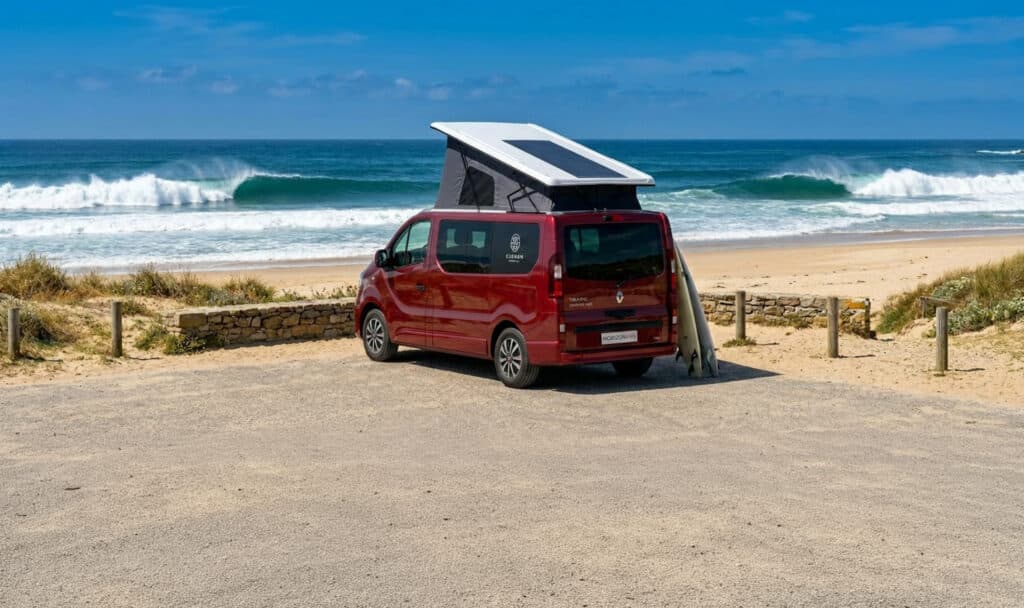
Travelling in a campervan is all about freedom: taking your time, finding a lovely spot and stopping whenever you like. To make this possible, it’s essential to be able to travel independently for several days, and this is entirely possible with a campervan fitted with a solar panel. From choosing the panel to selecting the type of battery, it all comes down to ensuring the system is properly integrated.
Glénan Concept Cars, experts in campervans, explain how the on-board power system works, what level of solar power to choose, and why a well-integrated solution tangibly improves your comfort and range whilst travelling.
Travelling for several days without recharging your battery is perfectly possible with a campervan fitted with a high-performance solar panel. In a campervan designed for a nomadic lifestyle, striking the right balance between solar panels, batteries and power consumption gives you greater freedom – provided you choose the right system and the right power rating. Glénan Concept Cars, with over twenty years’ experience in van conversions, helps you understand how on-board electricity works, which solar solution to choose, and why our range of products specifically meets the autonomy needs of travellers in 2026.
Campervan fitted with a solar panel: understanding how the electrical system works
The electrical autonomy of a campervan is based on a simple principle: the solar panel captures the sun’s energy, a regulator converts it into electricity which is stored in the battery, and this battery powers the vehicle’s electrical appliances. A well-designed system ensures a comfortable level of energy autonomy.
From the solar panel to the battery: the basic circuit
In a well-designed system, the solar panel generates solar energy as soon as it receives light. This energy is then channelled through a charge controller, which protects the battery from overcharging and optimises the charging process. The lithium battery then stores this energy to power everyday appliances: lighting, a fridge, USB sockets and a water pump, depending on the equipment.
To put it simply, the route goes like this:
Solar panel → Charge controller → Battery → Load
This principle seems simple, but it is essential. It determines the quality of your self-sufficiency, the system’s efficiency and how long you can go without plugging your Glénan Concept Cars campervan into the mains.
Why an installation should be conceived as a whole
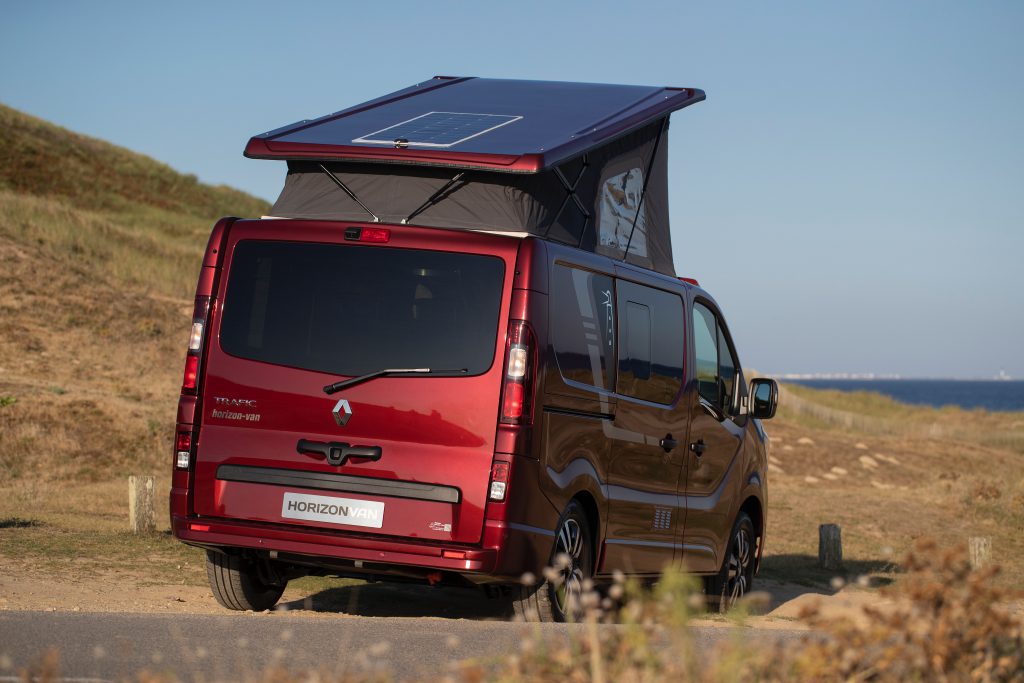
A good solar kit involves more than just fitting a solar panel on the roof. You also need to fit the battery and the charge controller, the type of mounting and your van’s actual fuel consumption. An oversized or poorly installed system can end up costing more without delivering the expected benefits, whereas a well-designed solution genuinely improves life on board.
Furthermore, the vehicle’s overall height must also be taken into account. Thanks to its reverse-power system, the ultra-slim 210W monocrystalline solar panel fitted by Glénan Concept Cars ensures that the Renault Trafic remains under 2 metres in height.
This is why the expertise of a designer such as Glénan Concept Cars is essential: the solar system must be tailored to the needs of the journey, the type of vehicle, how it is used on board and how well it integrates with the roof.
What solar power system should you choose for a bespoke campervan?
The ideal power output depends on your travel habits. If you’re mainly using the lights and a small fridge, a basic system may be sufficient. If you’re going away for longer, with more appliances on board, you’ll need to consider a more powerful system.
Comparison of common solar power ratings
| Power | Suitable uses | Estimated range | Weather background |
|---|---|---|---|
| 100 W | Lighting for occasional, small-scale use | Limited battery life, suitable for short stays | Good sunshine only |
| 210 W | Fridge, lighting, regular recharging | Good battery life under standard use | More versatile use |
A 210W solar panel is an attractive option for a campervan that is used regularly. Whilst it does not guarantee complete self-sufficiency, it does help to offset the power consumption of your van’s equipment on longer trips.
The importance of actual consumption
Choose the panel’s power That’s not enough: you also need to look at daily consumption. A fridge, a few LED lights and charging mobile phones do not require the same amount of power as more intensive use involving a computer, a pump, a space heater or an electric kitchen appliance.
In practice, the more specific your requirements are, the more accurately the battery life can be calculated. This helps to ensure you don’t end up choosing a solar kit that is either under-specced or unnecessarily expensive.
When does a 210 W panel become a viable option?
For a well-balanced nomadic trip, a 210 W solar panel is often a good compromise. It provides a stable supply of energy for everyday needs, whilst keeping a low profile on the roof. This is particularly useful in a campervan, where the vehicle’s height needs to be kept within limits to maintain its everyday versatility.
Lithium vs AGM batteries: which should you choose for your self-sufficient van?
The battery is the heart of the system. Without it, the energy generated by the solar panel cannot be stored efficiently. There are two main types: AGM batteries and lithium batteries. The choice directly affects the weight, service life, depth of discharge and ease of use.
Comparison table: lithium vs AGM
| Criteria | AGM battery | Lithium battery |
|---|---|---|
| Weight | Bulky | More compact |
| Service life | Correct | Very high |
| Discharge depth | More limited | Most important |
| Charging time | Slower | Faster |
| Yield | Medium | Very good |
| Cost | More accessible | Higher |
| Energy density | Basic | Most important |
The 100 Ah lithium battery available from Glénan Concept Cars offers a real advantage for travellers seeking greater freedom. It withstands repeated charging cycles better, recharges more efficiently and makes everyday use more convenient.
Why lithium has become the benchmark
Lithium is appealing for several reasons. It is lighter, can withstand more charge cycles and delivers stored energy more efficiently. In a campervan, this translates into greater efficiency, fewer constraints and better real-world range.
AGM batteries remain a viable option in certain cases, particularly on a tighter budget. However, as soon as you want a vehicle that is more self-sufficient, more practical and better suited to regular use, lithium batteries clearly have the edge.
The right balance for real-world use
For a couple, a family or a traveller who enjoys self-catering camping, the combination of a solar panel and a lithium battery (fitted as standard) is often the best option. It allows you to space out recharging sessions and use your van with greater freedom, without having to rely constantly on campsites or charging points.
The specific challenges of fitting the system to a Renault Trafic van
Installing a solar panel on a Renault Trafic requires taking several technical constraints into account. The roof surface, waterproofing, mounting and aesthetic integration must all be properly managed to ensure a long-lasting result. A proper installation must not adversely affect the vehicle or its day-to-day use.
Why the Trafic’s roof requires real expertise
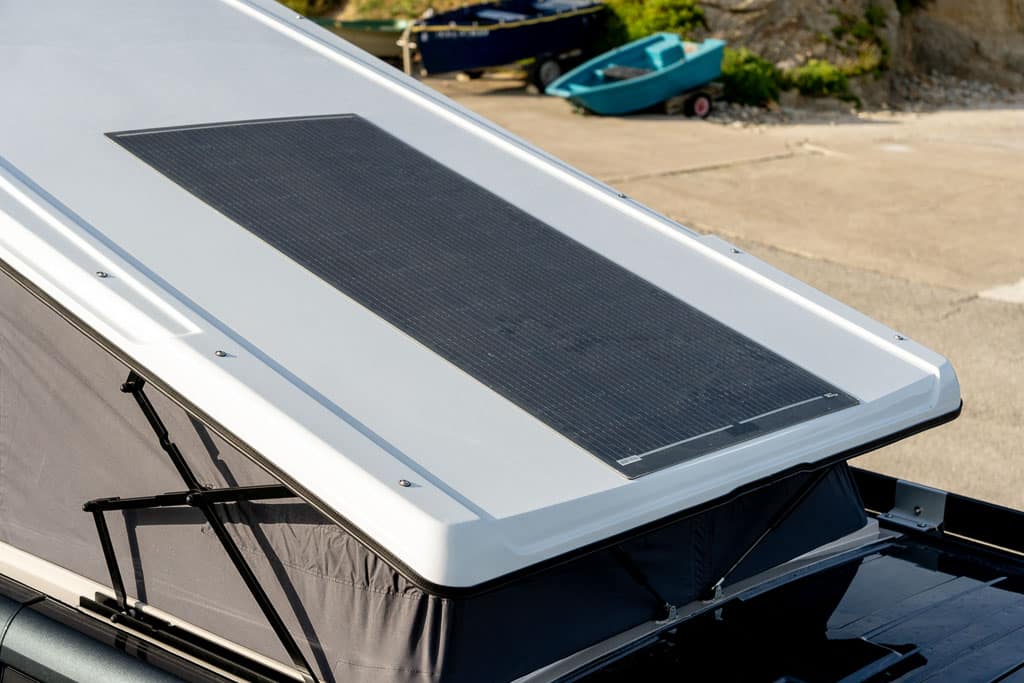
The Renault Trafic is an excellent base for a campervan conversion, but it is important to bear in mind that the solar panel is fitted to the pop-up roof of our Horizon modelsVan. The sign must be securely fixed without creating excessive wind resistance or adversely affecting the overall height. This is just as important for traffic flow as it is for parking and access to certain car parks or height restrictions.
How does Glénan Concept Cars go about its work?
At Glénan Concept Cars, the monocrystalline solar panel The 210W ultra-slim unit is bonded to the roof, with a remote power supply unit located beneath the roof. This arrangement ensures that the vehicle’s height is not affected. A sealing strip is also fitted to secure the assembly.
This solution is appealing because it combines discretion, high-quality finish and efficiency. It fits in well with the ethos of a premium campervan, where the aim is to achieve both performance and elegance.
Installation by a professional or DIY: what you need to know
Fitting the system yourself may seem appealing, but it carries risks: poor waterproofing, unsuitable wiring, an incorrectly sized controller, loss of performance or a fastening issue. Professional installation ensures the whole system is secure and guarantees greater durability.
For a buyer looking for a vehicle that’s ready to hit the road, a fitted-out package from a specialist is often the most reassuring option. The system is designed as a complete unit, rather than as a collection of separately fitted components.
The solar option at Glénan Concept Cars
Glénan Concept Cars offers a clear and comprehensive range of solar panels, designed for users who want to increase their autonomy without complicating their project. This option is based on a monocrystalline solar panel 210W ultra-slim, paired with a standard 100 Ah lithium battery.
The solar kit costs €990. At this price point, it’s a genuinely worthwhile option for travellers who wish to space out their stops at campsites or parking areas in order to recharge the battery. Under standard use – with the lights and fridge on – and in average sunlight conditions, the battery life is 3 to 4 days.
Most importantly, this solution does not simply involve adding another piece of equipment. It forms part of a broader approach to energy self-sufficiency: fewer constraints, greater freedom and a better quality of life on board.
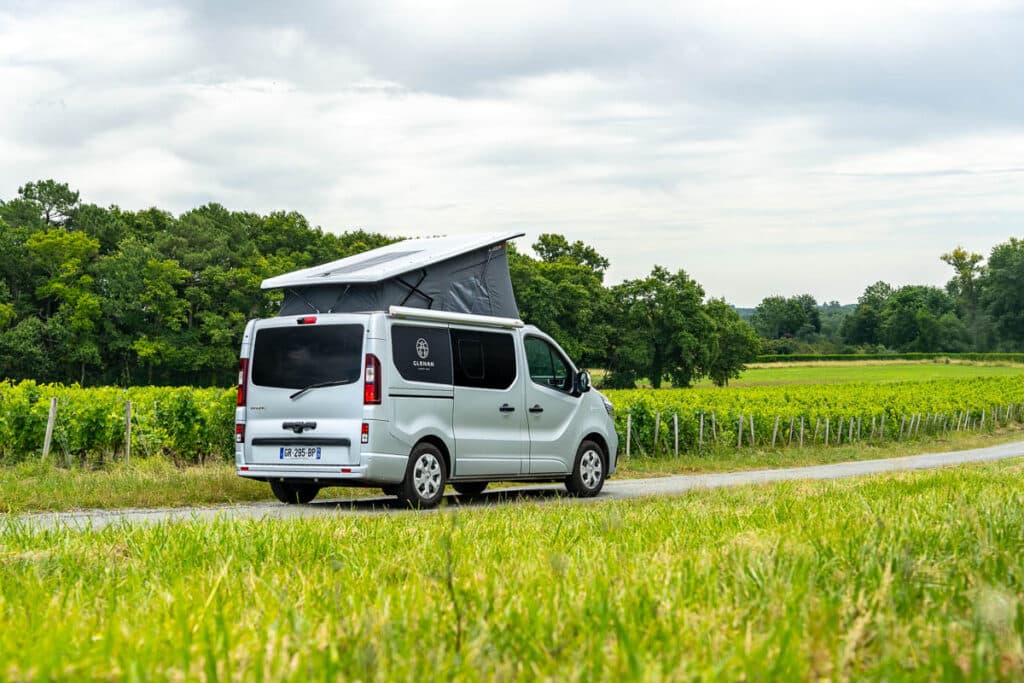
To find out more, you can explore the Horizon modelVan UP as well as the Glénan Concept Cars configurator to tailor your project to your needs.
Examples of true independence whilst travelling
In real life, the range depends on several factors: the weather, the length of stay, how often the appliances are used, and the type of campervan. A couple heading off for three days in Brittany, using the lights and fridge as normal, will not have the same needs as a family working on board with a laptop and frequent charging.
Why practical experience matters
The expertise of an experienced installer such as Glénan Concept Cars is essential, as it helps to avoid theoretical solutions that do not work well in practice. A well-designed solar installation must meet practical needs, not just the specifications on a technical data sheet.
Check with a reliable source
To gain a better understanding of the basic principles of solar energy and self-sufficiency, you can consult a technical reference source such as ADEME, which provides educational content on energy and domestic uses. This provides a reliable guide to the how solar power works in general before moving on to an on-board solution.
Frequently asked questions about solar panels integrated into your campervan
Which solar panel should you choose for a campervan?
The choice depends on your actual needs. For standard use, a 210 W panel offers a good balance between discretion, power output and battery life.
Is a lithium battery really useful?
Yes, because it offers better performance, a longer service life and a greater depth of discharge than an AGM battery.
Is a solar panel enough to be self-sufficient?
The solar panel helps a great deal, but the system’s autonomy also depends on the battery, energy consumption and the weather. You need to consider the system as a whole.
Does the Glénan Concept Cars kit alter the vehicle’s height?
No, the panel is ultra-thin and fitted in such a way that it does not affect the vehicle’s overall height.
Can you go several days without being connected to the mains?
Yes, in standard use, the system allows you to space out your stops at campsites or parking areas, especially when there is plenty of sunshine.
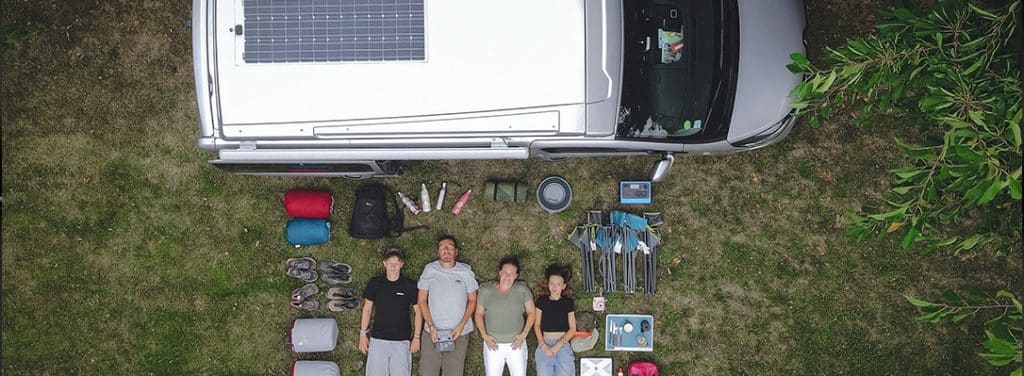
A converted van with a solar panel A well-designed system genuinely enhances your travel experience. It gives you greater freedom, helps you manage on-board power more effectively and allows you to travel with greater peace of mind, without having to rely constantly on an external power supply. With its ultra-slim 210W solar panel, 100 Ah lithium battery and integrated installation, Glénan Concept Cars offers you a simple, reliable solution tailored to the needs of today’s travellers.